Injector Data Done Right: Slopes, Offset, and Breakpoint Without the Guesswork
Wrong injector data is the most common hidden fault in an otherwise good tune. What high slope, low slope, breakpoint, and offset actually control, the unit traps that ruin them, and how to verify yours from a datalog.
By TuneVault
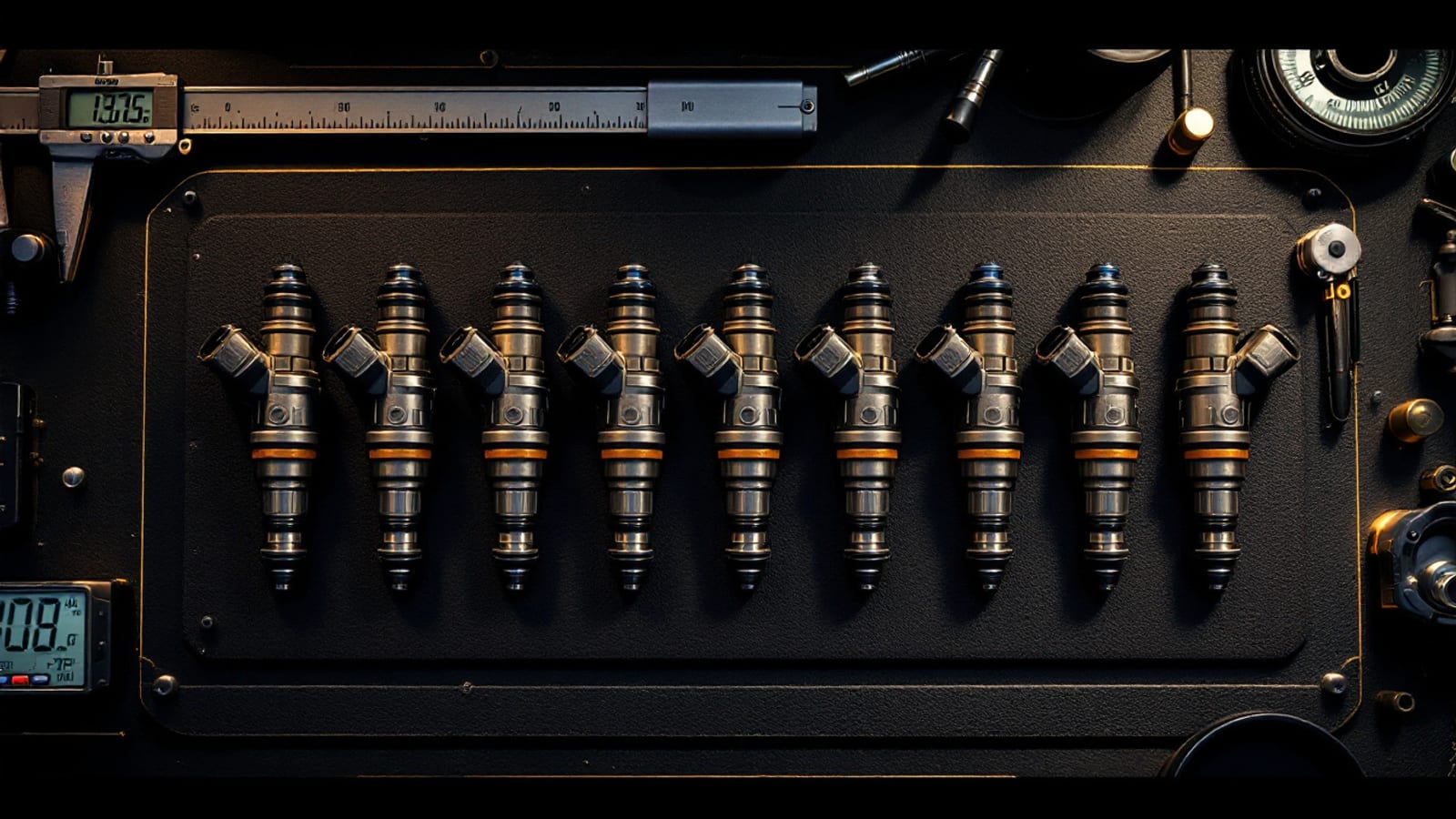
There is a specific kind of tuning problem that wastes entire weekends: the car fuels correctly in one part of its operating range and badly in another, so you chase the airflow model, and every correction you make in one region breaks another. Nine times out of ten the airflow model was fine and the injector data was wrong.
Injector characterisation is unglamorous, easy to get subtly wrong, and sits underneath everything else in the fuel system. As of July 2026 the four parameters below are still the ones HP Tuners uses to describe an injector, and they have not fundamentally changed in years — which is why the same mistakes keep recurring. Get it right and the rest of the tune becomes straightforward. Get it wrong and you will spend months compensating for it in tables that were never the problem.
What the computer is actually doing
The engine control module decides how much fuel a cylinder needs, then works out how long to hold the injector open to deliver it. That translation — grams of fuel into milliseconds of open time — is entirely dependent on the calibration's description of the injector.
That description is not a single flow number, because an injector does not behave like a tap that flows at a fixed rate whenever it is open. At very short pulse widths, the mechanics of the pintle opening and closing dominate the total fuel delivered. At longer pulse widths, the injector spends most of its open time fully open and flow becomes essentially linear.
Four parameters describe that behaviour:
- Low slope — flow rate per unit of open time in the short-pulse region.
- High slope — flow rate per unit of open time in the long-pulse region.
- Breakpoint — the pulse width at which the calibration switches from one model to the other.
- Offset (dead time / latency) — how long after being commanded the injector actually starts flowing, as a function of battery voltage.
Get these four right and the computer's fuel arithmetic is trustworthy from idle to redline. Get one wrong and it is trustworthy only in the range where that parameter happens not to matter much.
The four parameters, and what goes wrong with each
| Parameter | Governs | Symptom when wrong | Where you notice it |
|---|---|---|---|
| Low slope | Short-pulse fuelling | Trims swing at idle and light load | Idle, deceleration, gentle cruise |
| High slope | Long-pulse fuelling | AFR drifts from commanded under load | Wide-open throttle, hard acceleration |
| Breakpoint | Where the model switches | Hesitation or a fuelling step at one load point | A repeatable spot in normal driving |
| Offset | Opening delay vs voltage | Worse at low voltage; erratic cold-start and idle | Cranking, cold idle, electrical load on |
Read that table carefully and a diagnostic shortcut appears. The region where the fuelling is wrong tells you which parameter to suspect. Idle-only problems point at low slope or offset. Load-only problems point at high slope. A specific, repeatable transition point points at the breakpoint. A problem everywhere points at something other than injector data — probably airflow.
That is a genuinely useful triage, and it is the opposite of what most people do, which is to assume any fuelling problem is a volumetric efficiency or MAF issue.
The unit traps
More tunes are broken by units than by any conceptual misunderstanding.
Offset in seconds versus milliseconds. This is the big one. A data sheet may publish offset in one unit and the software field may expect the other. The error factor is a thousand, so the result is either an offset so large the car floods at idle or one so small it effectively does not exist. If short-pulse fuelling makes no sense at all, check this before anything else.
Flow rate units. Injector flow is quoted variously in pounds per hour, cubic centimetres per minute, and grams per second depending on who is writing. The conversions are simple; forgetting to do one is not.
Fuel pressure assumptions. Published flow figures are quoted at a specified base pressure. Flow through an injector varies with the pressure differential across it, so a set characterised at one pressure and installed on a system running another will not match its own data sheet. If you have changed the regulator or moved from a returnless to a return system, the numbers need correcting for the pressure you actually run.
Fuel type. Characterisation performed on one fuel does not transfer perfectly to another with different density and energy content. Reputable manufacturers publish separate data where it matters.
Our injector data page covers these checks in the context of a full tune, and the injector size calculator is a fast sanity check on whether the injectors are even in the right range for your power target before you worry about the fine detail.
Where to get the numbers
From the injector manufacturer. Several manufacturers publish characterisation data prepared specifically for HP Tuners, and where that exists it is by a wide margin the best starting point. Our DeatschWerks injector data reference covers what those data sets contain and how to enter them, and the injector slopes reference goes deeper on the slope model itself.
From the factory calibration, if the injectors are stock. The file already in your computer describes the injectors the engine was built with. If you have not changed them, that data is correct by definition — do not "improve" it.
From your own verification. Whatever source you start from, the numbers are confirmed on your car, not on a data sheet. That is the next section.
Not from a forum post about a similar part. Injectors from the same manufacturer with adjacent part numbers can characterise differently, and a set that has been in service for years may not match a new one's published data. Use a starting point that names your exact part.
Verifying injector data on your car
The verification method is simple and it uses the fuel trims the computer is already calculating for you.
- Get the engine fully warm and into closed loop. Cold-enrichment behaviour will muddy every reading.
- Log short-term and long-term fuel trims at idle and light load. If the trims sit near zero, your short-pulse fuelling — low slope and offset — is broadly correct.
- Log commanded against delivered air-fuel ratio under load. If they agree through a full pull, your long-pulse fuelling — high slope — is broadly correct. The AFR and lambda calculator converts units if your wideband reports lambda.
- Look for a discontinuity. Drive a smooth, gradual load increase and watch for a step in air-fuel ratio at one repeatable point. That step is your breakpoint landing in the wrong place.
- Test at varying electrical load — headlights, blower, everything on — and watch idle trims. Offset problems get worse as system voltage drops, so a car whose idle fuelling changes with electrical load is telling you the offset table is wrong.
The critical discipline is doing this before you correct the airflow model. If you tune VE or MAF first with bad injector data underneath, you bake the injector error into the air model, and the whole calibration becomes a set of two errors that cancel in the conditions you tuned and diverge everywhere else.
Our datalog channels reference explains each of the channels above, and the how to read a datalog guide walks through reading a full pull.
The order that saves rework
For any car where injectors have been changed:
- Read and archive the existing calibration. Always first — see the tune file management guide.
- Enter the manufacturer's characterisation data for your exact part number and fuel pressure.
- Verify the units. Twice. Especially offset.
- Confirm short-pulse fuelling with idle and light-load trims.
- Confirm long-pulse fuelling with commanded versus delivered air-fuel ratio under load.
- Only then correct the airflow model — the MAF and VE correction calculator handles the arithmetic.
- Re-verify trims across the full operating range.
- Move on to spark.
Steps two through five typically take one afternoon. Skipping them typically costs several weekends spread across a month, and often a corrupted VE table that has to be thrown away.
Bigger injectors are not automatically better
A common instinct on a modified car is to fit the largest injectors that will physically go in, on the theory that headroom is free. It is not.
An oversized injector spends more of its life in the short-pulse region where behaviour is least linear and characterisation matters most. At idle it may be operating at pulse widths where small errors in offset and low slope produce large percentage fuelling errors. The result is a car that is well-fuelled at wide-open throttle and unstable at idle — which is exactly the failure mode this article opened with.
Size the injectors for the fuel demand you actually have, with sensible headroom, and check injector duty cycle at the top of a pull to confirm you have enough. Duty cycle is data. Part-number ambition is not.
Where TuneVault fits
TuneVault reads your injector data straight from your VCM Editor screenshots and checks it against the parts you tell it are installed — including the unit traps, which are the whole reason a machine reading the numbers beats a person skim-reading them at midnight. It flags a breakpoint sitting in an awkward place, an offset with a magnitude that cannot be right, and slope values inconsistent with the flow rating you specified.
Then, after you flash, the datalog pass checks whether the fuelling actually behaves the way the data says it should — commanded against delivered air-fuel ratio, trims at idle and cruise, duty cycle at peak. See the injector data page for the workflow, or start a tune and have your current numbers checked before you drive on them.
The bottom line
Injector characterisation is the foundation the rest of the fuel system stands on, and it fails quietly — the car runs, it just runs correctly only some of the time. Learn to read the symptom pattern (idle problems point at offset and low slope, load problems at high slope, a repeatable step at the breakpoint), start from your manufacturer's data for your exact part at your actual fuel pressure, check the units twice, and verify with trims before you go anywhere near the airflow model. That sequence turns a multi-weekend mystery into an afternoon.
Frequently asked questions
What do high slope and low slope actually mean?
They describe how much fuel an injector delivers per unit of open time, in two separate ranges. Injectors do not behave linearly across their whole operating window — at very short pulse widths the opening and closing behaviour dominates, and at longer pulse widths flow becomes close to linear. Low slope describes the short-pulse region, high slope the long-pulse region, and the breakpoint is where the calibration switches between them.
What is the injector breakpoint?
The pulse width at which the calibration stops using the low-slope description and starts using the high-slope one. Set it too low and short-pulse fuelling is calculated with the wrong model, which shows up as poor idle and unstable trims at light load. Set it too high and the transition lands in the middle of everyday cruise, producing a fuelling discontinuity that feels like a hesitation.
What does injector offset do?
Offset, also called dead time or latency, accounts for the time between the computer commanding the injector open and fuel actually flowing. It varies with battery voltage, which is why it is a table rather than a single number — at lower voltage the injector opens more slowly and needs more compensation. Wrong offset produces fuelling errors that are worst at short pulse widths, so idle and light cruise suffer most.
What are the symptoms of wrong injector data?
The classic pattern is a car that fuels correctly in one part of its range and badly in another — for example clean at wide-open throttle but with fuel trims swinging at idle, or the reverse. Because that looks like an airflow problem, people frequently corrupt a perfectly good VE or MAF table trying to compensate. If your trims disagree strongly between low and high load, suspect injector data before you touch the air model.
Can I just use the injector manufacturer's published data?
Start there — reputable manufacturers publish characterisation data for HP Tuners specifically, and it is far better than guessing. But confirm the units match what the software expects and that the data is for your exact part number and fuel pressure. Published data is a starting point that then gets verified on your car with fuel trims, not a value you enter and never check.
What is the most common injector data mistake?
Entering offset in the wrong unit — seconds where the field expects milliseconds, or the reverse. The magnitude error is a factor of a thousand, so the car either barely runs or ignores the offset entirely. It is trivially easy to do when copying numbers from a data sheet and it is the first thing worth re-checking when short-pulse fuelling is inexplicably wrong.
Do injectors need different data at different fuel pressures?
Yes. Flow through an injector depends on the pressure differential across it, so a set characterised at one base pressure will flow differently at another. If you have changed the fuel pressure regulator or run a return-style system at a different pressure than the characterisation used, the published data no longer describes your installation and needs correcting.