Injector Duty Cycle and Fuel Pump Headroom: How to Tell You've Outgrown Your Fuel System
Running out of fuel system is the most common way a tuned engine gets hurt, and it announces itself in a datalog long before it happens. What duty cycle really means, how to read fuel pressure under load, and the numbers that say stop.
By TuneVault
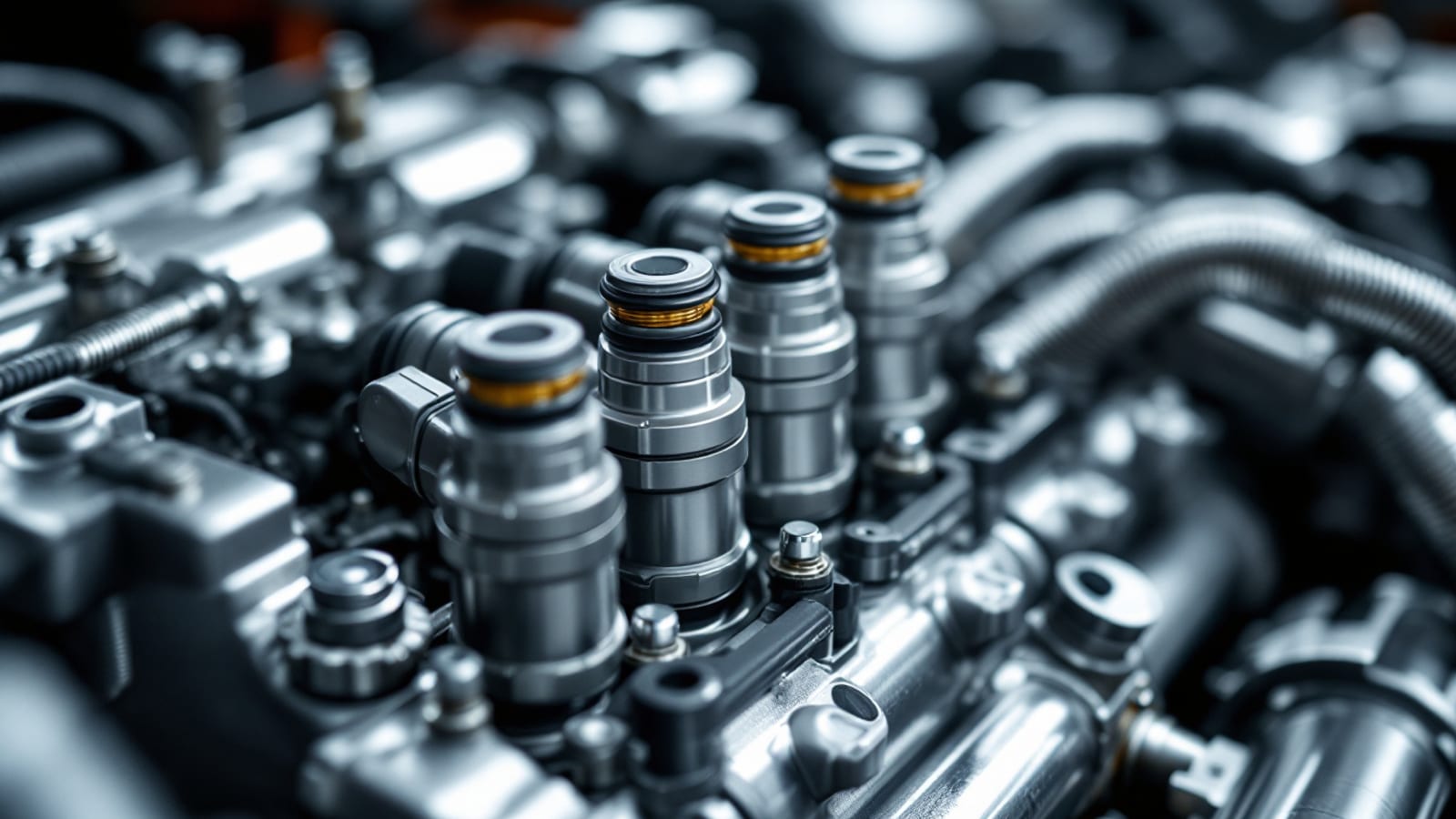
The fastest way to hurt a tuned engine is to run out of fuel system at the top of a pull. It is not a dramatic failure — nothing bangs, no light comes on — the mixture simply goes lean in the last part of the rev range, where cylinder pressure and heat are highest and lean is least survivable.
The consoling part is that it is entirely predictable. A fuel system that is about to run out says so in a datalog several weeks before it actually does, in two channels most people either do not log or do not look at. As of September 2026 this remains one of the most avoidable engine failures in DIY tuning.
Two different ceilings, one symptom
When people say "I ran out of fuel system", they mean one of two quite different things, and the fix for each makes the other worse.
Injector saturation. The injector is open as much as it can be. Duty cycle is the percentage of the available time an injector spends open, and at 100% it is open continuously. The computer can ask for more fuel all it likes; there is no more open time to give.
Pump saturation. The pump cannot deliver the volume the injectors are demanding at the pressure the system requires. Rail pressure falls, so each millisecond of open time delivers less fuel than the calibration assumed, and the engine goes lean even though duty cycle may look acceptable.
Both look identical from the driver's seat: a lean condition that only appears near redline and vanishes when you lift. Distinguishing them requires exactly one extra channel — fuel pressure — and getting it wrong means buying the wrong parts. Fitting bigger injectors to a pump-limited car makes the problem worse, because larger injectors demand more volume from a pump that already could not keep up.
What duty cycle is actually measuring
Duty cycle is a ratio, and both halves of it move.
The numerator is how long the injector must stay open to deliver the required fuel, which rises with airflow, with boost, and with any target enrichment the calibration is applying under load.
The denominator is how much real time exists between injection events, which falls as engine speed rises. At 7,000 RPM there is roughly half the wall-clock time per cycle that there was at 3,500.
Both move in the wrong direction at once as you climb the rev range, which is why duty cycle curves upward steeply rather than linearly. An engine sitting at a comfortable 60% at 4,000 RPM can be at 95% by 6,800 without anything being wrong with the tune — that is simply arithmetic.
The consequence is that duty cycle must always be evaluated at the top of the pull, not averaged across it. A log summary that reports a peak duty cycle of 70% for the run tells you nothing useful if it never reached the last thousand RPM.
The numbers that matter
| Reading at peak power | What it means | What to do |
|---|---|---|
| Duty cycle under 80%, pressure steady | Comfortable headroom | Nothing — this is where you want to be |
| Duty cycle 80–85%, pressure steady | Working ceiling reached | Usable, but no margin for hot weather or fuel variation |
| Duty cycle above 90%, pressure steady | Injectors saturating | Injectors are the limit; larger ones are the correct fix |
| Duty cycle moderate, pressure falling with RPM | Pump running out of flow | Pump or supply is the limit; do not fit bigger injectors |
| Duty cycle high and pressure falling | Both at their limit | Fuel system needs a complete rethink, not one part |
| Wideband leaning only near redline | Something ran out — cause not yet known | Log pressure before buying anything |
The last row is the one to internalise. A lean condition at the top of the rev range is a symptom, and both failures produce it. The temptation is to buy injectors because they are the part everyone talks about; the diagnostic is a $40 pressure sensor input and one pull.
Reading fuel pressure correctly
Fuel pressure is not a single expected number, because different systems regulate it differently.
On a return-style system with a vacuum-referenced regulator, rail pressure tracks manifold pressure — it falls slightly at idle under high vacuum and rises with boost, maintaining a constant differential across the injector. What you are checking is that the differential stays constant. Pressure that fails to rise with boost is the same failure as pressure that falls, because the injector only cares about the difference across it.
On a returnless system, the module holds a fixed rail pressure and the calibration compensates for manifold pressure mathematically. Here you are checking that the commanded pressure is actually achieved. Many platforms report both commanded and actual pressure, and the gap between them under load is exactly the diagnostic you need.
Either way, the test is the same: a wide-open-throttle pull through the full rev range with pressure logged. A healthy system holds its expected value from the moment the throttle opens until you lift. Any progressive decline as RPM climbs is flow-limited supply, and it is worth checking the simple causes first — a clogged filter, an undersized supply line, a failing pump, or a voltage drop to the pump that means it is not being driven as hard as you think.
That last one is more common than it should be. Pump flow depends heavily on the voltage it actually receives, and a degraded connector or an undersized wire that was adequate for a stock pump can starve an upgraded one. Log battery voltage alongside pressure.
Doing the arithmetic before you spend money
You can estimate what you need before buying anything, and the estimate is close enough to prevent expensive mistakes.
The relationship is straightforward: the fuel an engine needs is proportional to the power it makes, scaled by how efficiently it converts fuel into power. That efficiency figure — brake specific fuel consumption — is roughly known for engine types: a naturally aspirated port-injected engine sits at one value, a boosted engine running richer targets sits higher. Multiply target power by that figure, divide across the number of injectors, and add margin so peak duty cycle lands in the low eighties rather than the high nineties.
Our injector size calculator does that arithmetic with sensible defaults, which is a better starting point than the forum habit of copying whatever injector someone else fitted to a superficially similar build. Two engines making the same power on different fuels at different targets have genuinely different requirements.
Then treat the result as a floor, not a target. Sizing so that peak duty cycle lands at exactly 85% on a mild day leaves no room for a hot afternoon, a tank of poor fuel, or the pump's flow degrading with age — all of which will happen.
When the fuel changes, so does everything
Ethanol content is the single largest step change in fuel system demand, and it catches people out because the engine seems fine right up until it is not.
A high-ethanol blend carries meaningfully less energy per unit volume than gasoline, so the engine needs roughly a third more fuel by volume to make the same power. A fuel system with comfortable headroom on pump gasoline can be at its ceiling on E85, and a flex-fuel car that switches blends between fill-ups moves between those two states without telling the driver.
This is why fuel system capacity belongs at the front of any flex-fuel conversion rather than being discovered afterwards. It is also why the same car can pull cleanly all summer and go lean at the top of third gear after one winter fill-up.
What "having headroom" is actually worth
There is a natural objection here: if the car makes its power at 95% duty cycle, why spend money to make the same power at 78%?
Because duty cycle is not the only thing that consumes the margin.
- Ambient temperature. Denser air on a cold morning means more airflow, which means more fuel demand at the same throttle position. Winter pulls demand more fuel than the summer pulls you calibrated on.
- Fuel variation. Pump fuel is not consistent between stations or seasons.
- Component ageing. Pumps lose flow gradually. A pump at the edge of adequate when new is inadequate in two years, and it degrades slowly enough that you will not notice until a lean pull.
- The tune itself changing. More boost, more timing, a colder intake — every improvement raises fuel demand.
Headroom is what keeps all four of those from mattering. Running with none means the engine is one hot day away from a lean top end, which is the condition knock is most likely to appear in and least likely to be survivable.
Reading a pull for fuel system health
Log a full-throttle pull in a gear that gives you several seconds of load — third is usually right — and look at four things in order:
- Wideband air-fuel ratio across the whole pull. Does the actual mixture track the commanded target all the way to redline, or does it drift lean in the last portion?
- Fuel pressure across the same window. Steady is healthy. Declining is supply-limited.
- Peak duty cycle at peak RPM. Not the average, not the peak-power point — the highest engine speed reached.
- Knock retard. Lean and hot at high RPM is the exact condition that produces it, and its appearance late in a pull frequently traces back to fuelling rather than to the timing table.
If the mixture holds target, the pressure is steady and duty cycle is in the seventies, the fuel system is genuinely healthy and you can look elsewhere for gains. If any of those three are marginal, that is the constraint on the whole build regardless of what else you change. Our guide to reading a WOT datalog walks through what a clean pull looks like channel by channel.
Where TuneVault fits
Fuel system limits are a good example of something visible in the file plus one log. The Copilot reads your commanded fuelling targets and injector data out of the VCM Editor file, compares them against what your datalog shows the system actually delivering at high RPM, and flags a system running out of margin before the pull that finds out the hard way. It is part of the same $39 guided tune, and it is a great deal cheaper than the alternative diagnostic method.
The bottom line
Two components can run out, and they need opposite fixes. Injector saturation shows as duty cycle climbing past 90% with steady rail pressure. Pump saturation shows as falling pressure with duty cycle that never looked alarming. Both appear as a lean top end.
Log fuel pressure alongside duty cycle on every full-throttle pull, evaluate both at the highest RPM you reach rather than on average, and size the system so the peak lands in the low eighties instead of the high nineties. The margin you are buying is not power — it is the ability to survive a hot day, a bad tank and two years of pump wear without a lean pull at redline. Compared with the cost of a professional tune or an engine, it is the cheapest insurance in the build.
Frequently asked questions
What is injector duty cycle?
The percentage of each engine cycle that an injector spends open. At 50% duty cycle the injector is open for half the time available; at 100% it is open continuously and can deliver no more fuel no matter what the computer asks for. Duty cycle rises with both fuel demand and engine speed, because higher RPM leaves less real time between injection events.
What duty cycle is too high?
Most tuners treat about 85% as the practical working ceiling for a sustained pull, with anything above that reserved as margin rather than used. Beyond roughly 90% many injectors stop behaving linearly, so the fuel delivered no longer matches what the calibration calculated, and at 100% the system is saturated with no reserve at all. Running the top of the RPM range at 95% leaves nothing for a hot day, a bad tank of fuel, or a slightly failing pump.
How do I know if my fuel pump is the limit rather than my injectors?
Log fuel pressure during a full-throttle pull. A healthy system holds base pressure, or holds a constant offset above manifold pressure on a returnless-style setup, all the way to redline. If pressure sags as RPM climbs, the pump is running out of flow and the injectors are being starved regardless of what duty cycle says. Duty cycle alone cannot distinguish these two failures, which is why pressure is the channel that matters.
Why does the car go lean only at the top of the rev range?
Because demand rises with airflow while supply is fixed. At high RPM the injectors have the least real time to deliver the most fuel, and the pump is at its highest flow demand simultaneously. Whichever runs out first shows up as a lean condition that appears only in the last part of the pull and disappears the moment you lift, which is one of the more dangerous patterns in tuning because it looks fine everywhere else.
Does a bigger injector always fix a fuelling limit?
Only if the injectors were the limit. If the pump is the constraint, larger injectors make it worse, because they demand more volume from a pump that already could not supply enough. Diagnose which component is saturating before buying either, and remember that larger injectors also make idle and light-cruise fuelling harder to control because the same fuel now has to be delivered in a much shorter pulse.
Does E85 change the fuel system requirement?
Substantially. Ethanol blends carry less energy per unit volume, so the engine needs roughly a third more fuel by volume for the same power. A fuel system with comfortable headroom on pump gasoline can be right at its limit on a high-ethanol blend, which is why fuel system capacity is the first thing to check before a flex-fuel conversion rather than an afterthought.
What channels do I need to log for this?
Injector duty cycle if your platform reports it, commanded injector pulse width, engine speed, fuel pressure, wideband air-fuel ratio and manifold pressure. Duty cycle and pressure together tell you which component is saturating; the wideband confirms whether the shortfall is actually reaching the mixture. Without pressure you are guessing between two different failures.