Coyote 5.0 Tuning: What Actually Changes When You Add Boost
The Coyote tunes beautifully naturally aspirated and punishes shortcuts under boost. What shifts in the fuelling, airflow, and spark strategy across generations, and the checks that keep a blown 5.0 alive.
By TuneVault
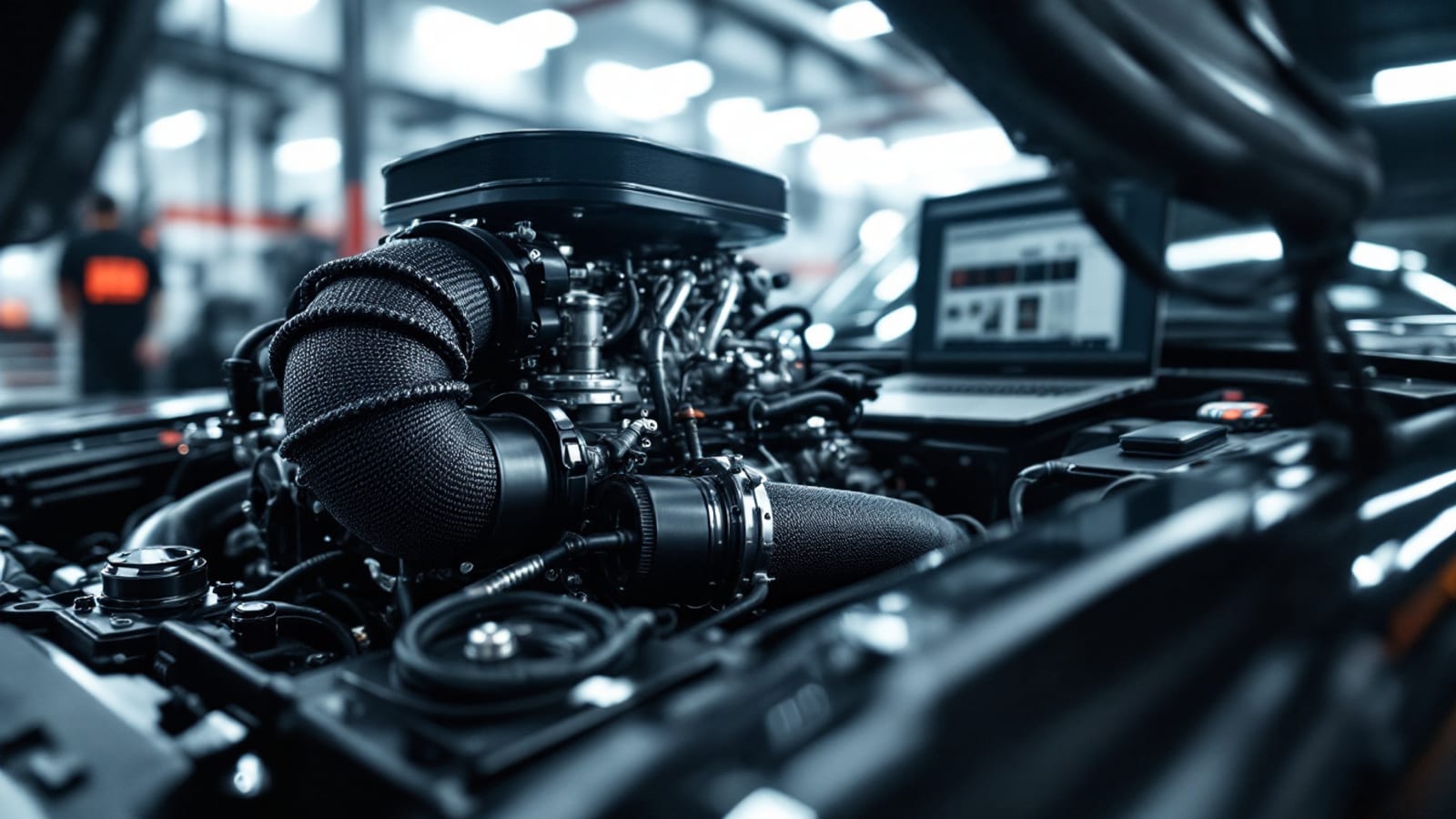
The Coyote is one of the most forgiving modern V8s to tune naturally aspirated and one of the least forgiving once you add boost. Same engine, same software, completely different risk profile — and the reason is not exotic. Everything that was a rounding error at atmospheric pressure becomes a real number when you are stuffing more air in.
This walks through what actually changes across the fuelling, airflow, and spark strategy when a 5.0 goes from naturally aspirated to boosted, generation by generation where it matters, plus the verification that separates a blown Coyote that lasts from one that does not. As of July 2026 that covers four distinct engine generations, and the differences between them are large enough that a "Coyote tune" means very little on its own.
Know which Coyote you have
The 5.0 has been through enough revisions that "Coyote" alone is not a specification. The differences matter to tuning:
- 2011–2014 (Gen 1). Port injection, the original architecture. Straightforward fuelling model, well-documented behaviour.
- 2015–2017 (Gen 2). Revised heads and intake, still port injected. Tunes much like Gen 1 with different numbers.
- 2018–2023 (Gen 3). Adds direct injection alongside port injection, and pairs with the ten-speed automatic in most applications. This is the biggest calibration change in the engine's life.
- 2024 onward (Gen 4). Further revisions to induction and fuel system.
- F-150 5.0 shares the engine family but lives in a truck with different gearing, cooling, and load duty. A calibration written for a Mustang is not a calibration for a truck.
Before anything else, confirm what HP Tuners supports for your specific year and control module. Coverage and licensing are decided by HP Tuners rather than by any tuning tool built on top of it — our coverage, credits, and VIN licensing article explains how to check before you spend money on an interface.
What boost actually changes
Four things shift, and they compound.
Cylinder pressure rises, so the same spark advance produces a much greater tendency to knock. The timing table that was conservative naturally aspirated is now aggressive.
Air charge temperature rises, because compressing air heats it. Intercooling recovers some of that, never all of it, and never at the same rate across repeated pulls. Your intake air temperature channel becomes one of the most important things in the log rather than a curiosity.
Fuel demand rises roughly in proportion to air, which puts the injectors and pumps under pressure they were not specified for.
The airflow model's assumptions break, because a supercharger or turbo changes the relationship between what the sensor sees and what the cylinders receive. If your air model is wrong, the fuelling is wrong at exactly the load where being wrong hurts most.
| Naturally aspirated Coyote | Boosted Coyote | |
|---|---|---|
| Spark strategy | Factory margins mostly usable | Start well below expectation, earn every degree |
| Airflow model | Factory calibration close to valid | Must be re-verified against the new induction path |
| Injector duty cycle | Rarely a limit | Frequently the first hard limit you hit |
| Fuel pressure | Steady, seldom examined | A primary safety channel, logged every pull |
| Intake air temp | Mild influence | Dominates how much timing is safe on the day |
| Consequence of an error | Usually a poor-running car | Potentially a damaged engine |
| Verification | Recommended | Non-negotiable, including heat-soaked |
Fuelling: where boosted Coyotes hit the wall first
On a port-injected Gen 1 or Gen 2, the fuel picture is comparatively simple: injector data must match the injectors installed, and the injectors must have duty cycle headroom at peak demand.
Getting injector data right is unglamorous and catches people constantly. Slope, offset, and breakpoint all have to describe the parts physically in the engine, and the unit conventions are a classic trap — an offset entered in the wrong unit produces a car that fuels correctly in one region and badly in another, which then gets misdiagnosed as an airflow problem. Our injector data page and the injector slopes reference cover the specifics, and the injector size calculator gives you a sanity check on whether the parts are even in the right range for your target.
Then log injector duty cycle at the top of a full pull. That number tells you whether your fuel system is the constraint. No parts recommendation from a forum replaces it.
Gen 3 and later add a second layer. With both direct and port injection, the calibration governs how fuel is split between the two systems across load and RPM, and the direct side depends on high-pressure fuel pump capability. Under boost you can hit a direct-injection supply ceiling that no port injector upgrade addresses. The practical consequence: on a boosted Gen 3, "are my injectors big enough" is only half the fuel question.
Whatever the generation, the verification is the same — command and delivery must agree. Log commanded against actual air-fuel ratio through the whole pull. The AFR and lambda calculator converts units if your wideband reads lambda and your tables are in AFR, and the AFR tuning page covers what targets are appropriate for a boosted pump-gas combination.
Airflow: the model has to match the new induction path
A supercharger or turbo changes the pressure and temperature at which a given mass of air reaches the cylinders, and often changes the physical intake path the mass airflow sensor sits in.
Two failure modes are common on blown Coyotes:
MAF saturation near peak power. The sensor reaches the top of its range and stops reporting increases, so the calibration under-fuels exactly at maximum load. The signature in a log is airflow flattening while RPM and boost keep climbing, with air-fuel ratio going lean at the same moment. Our MAF curve reference and the MAF calibration page walk through detecting and correcting it.
A relocated or enlarged intake changing the sensor's reading without the transfer function being updated. The car appears to run fine at cruise and drifts under load.
The MAF and VE correction calculator handles the arithmetic on the corrections. What it cannot do is tell you the model is right — only a log across the real load range does that.
Spark: earn every degree, and re-earn it when hot
This is where boosted engines are actually lost.
Start conservative. Log knock retard through the load range. Advance in small increments only in cells showing no retard, and re-log after each change. If retard appears repeatedly in the same cells, that is your combination's limit on that fuel — not a suggestion.
Then the part people skip: do it again heat-soaked. Make several back-to-back pulls, let intake air temperature climb the way it does on a real summer evening, and look at what the engine does on the third and fourth run. A calibration validated on one cool pass is validated for conditions you will not always have. The borderline spark and heat soak entries in the glossary explain the mechanism if you want the detail.
Our supercharged tuning guide covers the forced-induction spark discipline in more depth, and the spark and timing page covers the tables involved.
The four channels that decide whether it is safe
Every verification pull on a boosted Coyote comes down to reading these together:
- Commanded versus delivered air-fuel ratio. They track, or you stop.
- Knock retard. At or near zero through the pull, in the conditions you actually drive.
- Fuel pressure under full load. Steady. A pressure drop at the top of a pull is a lean condition arriving whether the AFR trace has caught up yet or not.
- Intake air temperature. Rising steeply pull over pull means your safe timing is shrinking as the session continues.
Our datalog channels reference explains what each number is measuring, and the how to read a datalog guide works through a complete pull. If you would rather have the log read for you, the datalog analysis page describes what the automated verdict covers.
Keep every version of the file
Boosted builds change. You add an intercooler, swap a pulley, change fuel, and each change wants a calibration revision. Without disciplined versioning you end up unable to answer the only question that matters when something goes wrong: what changed between the last good pull and this one?
Read and archive the stock calibration before your first flash, label every revision with the hardware and fuel it was written for, and keep the last known-good file somewhere you can reach it from your phone at a track. The tune file management guide sets out a scheme that survives a multi-year build.
Where TuneVault fits
TuneVault reads your VCM Editor tables from screenshots, checks the injector data against the parts you tell it are installed, flags lean wide-open-throttle regions and timing that is aggressive for your fuel, and gives you an ordered change list — safety first — before you flash. After the pull, it reads your VCM Scanner log and returns a plain go or no-go on the four channels above.
On a boosted Coyote the audit-before-flash step is the valuable one, because the errors that hurt are the ones present in the file before the car ever moves. See the Coyote 5.0 tuning page for the platform-specific workflow, the injector scaling reference for the fuelling detail, or start a tune to see where your current file stands.
The bottom line
Adding boost to a Coyote does not change the tuning process — it removes the slack. The same steps matter: airflow model verified against the actual induction path, injector data matching real parts, fuel system proven to have headroom, spark advanced only where the engine shows no knock, and everything re-checked when the car is hot. Naturally aspirated, skipping one of those produces a car that runs a bit worse than it could. Boosted, it produces a repair bill. Do them in order and a blown 5.0 is a genuinely reliable engine.
Frequently asked questions
What changes most when you boost a Coyote?
The margin for error collapses. Naturally aspirated, the engine tolerates a slightly optimistic airflow model or a little extra timing because cylinder pressure stays modest. Under boost, the same errors arrive at far higher pressure and temperature, so a lean spot that was harmless becomes damaging. Practically, three things move to the top of the list: fuel system headroom, the airflow model matching the new intake path, and a much more conservative starting point on spark.
Does the Gen 3 Coyote's direct injection change how you tune it?
Yes. From 2018 the Coyote runs both direct and port injection, and the calibration decides how fuel is split between them across load and RPM. That split is a genuine variable rather than a fixed property of the engine, and it interacts with high-pressure fuel pump capacity. A boosted Gen 3 can run into direct-injection fuel supply limits that simply do not exist on the earlier port-injected engines.
Do I need bigger injectors for a supercharged Coyote?
It depends on boost level and fuel, but injector duty cycle is the number that decides it, not opinion. Log duty cycle at the top of a wide-open-throttle pull — if it is running out of headroom, the injectors are the limiting factor regardless of what any parts list says. On the Gen 3 and later engines you also need to look at high-pressure fuel pump capability, because port injectors alone are not the whole fuel system.
How much timing is safe on a boosted Coyote on pump gas?
There is no single figure, because it depends on boost, intercooling, fuel quality, and intake air temperature on the day. The reliable method is to start well below where you expect to end up, log knock retard, and advance in small steps only where the engine shows no retard with margin. If you see repeated retard in the same cells across pulls, that is the limit for your combination and no table value overrides it.
Why does my Coyote pull timing after two or three pulls?
Heat. Intake air temperature climbs as the supercharger and intercooler heat-soak, and the calibration correctly reduces timing to protect the engine. A tune that is safe on the first pull can be marginal on the fourth, which is why verification has to include a heat-soaked log rather than one cool morning pass.
Is a MAF or speed density better on a boosted Coyote?
The factory strategy is capable, and the practical question is whether your intake path still matches what the airflow calibration expects. A relocated or enlarged intake changes the MAF's reading, and a supercharger changes the pressure the engine sees at a given airflow. Whichever model you run, the test is the same: do commanded and delivered air-fuel ratio agree through a full pull? If they do not, fix the air model before touching anything else.
Can I tune a boosted Coyote without a dyno?
Careful road tuning works on modest, well-intercooled setups where you can capture clean logs and stay within safe load. As boost and ambition rise, the case for a dyno gets stronger — you get repeatable load, controlled conditions, and somebody watching the engine while it works. The point at which that becomes worth the money arrives sooner on a blown engine than on a naturally aspirated one.