Rough Idle After a Cam Swap: The Tuning Fixes That Actually Work
A bigger camshaft changes what the engine can measure about itself at idle. Some of the roughness is real and fixable in the calibration, some of it is the camshaft doing exactly what you bought it for.
By TuneVault
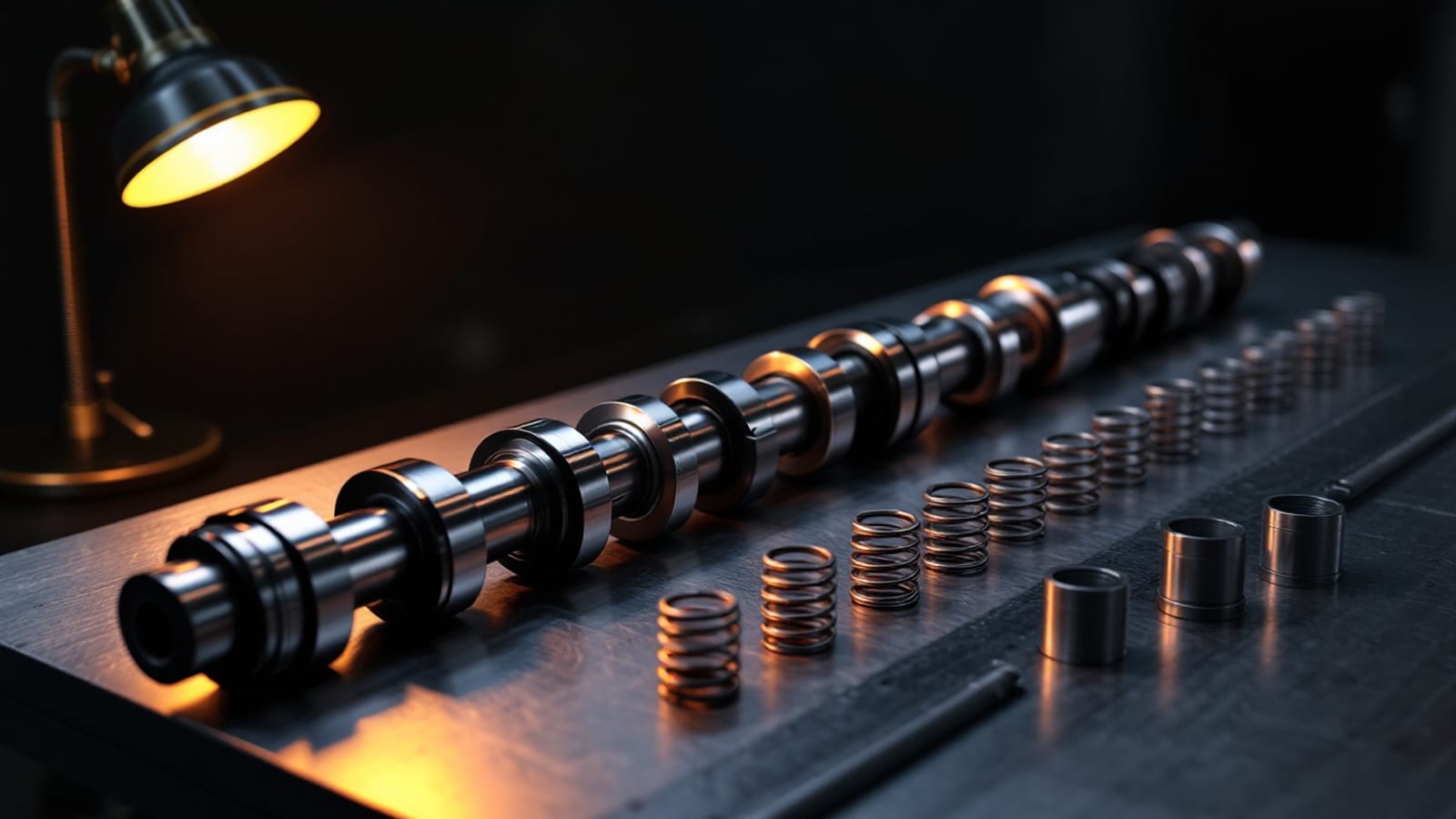
The camshaft is in, everything torqued, the engine started on the first try. It idles badly, hunts, and stalls at the first stop sign.
As of August 2026 this remains one of the most common post-install situations in DIY tuning, and the useful first move is to separate two different things that are both happening at once: the roughness you bought, and the roughness the calibration is causing.
The two kinds of rough
The camshaft's own character. A camshaft with more duration and more overlap fills cylinders unevenly at low speed. That uneven filling is a physical consequence of valve events overlapping while the engine is turning slowly, and it produces the lope people specifically choose these camshafts for. No calibration removes it, because it is not an error.
The calibration reacting badly. Everything else. The airflow model estimating wrongly at idle, the idle control system targeting an airflow value that suited a different camshaft, closed-loop correction chasing an oxygen sensor reading it should not trust, and timing that no longer suits the conditions. All of this is fixable, and all of it is what makes the difference between "lopey and stable" and "lopey and stalling".
The goal of idle tuning after a swap is to remove the second category entirely and leave the first alone.
Why the engine got confused
At idle a large camshaft changes three things the control system depends on:
- Volumetric efficiency drops at low speed and low load. The engine breathes less effectively at idle than it used to, and the VE table still describes the old engine. Our volumetric efficiency glossary entry covers exactly what that table claims.
- Manifold vacuum falls and becomes unstable. Speed-density fuelling depends on a meaningful, stable manifold pressure signal. On a large camshaft at idle it is neither — the reading is honest but far less informative than it was.
- Exhaust reversion contaminates the oxygen sensor. Overlap lets exhaust gas and fresh charge mix in ways that make the sensor report a mixture that does not represent what the cylinders actually burned. The closed-loop glossary entry covers why that matters.
So the controller is now estimating airflow badly, using a degraded pressure signal, and correcting against a misleading feedback sensor — all at the operating point where it has the least authority to recover. That is the whole problem, and every fix below addresses one part of it.
Fix them in this order
| Order | Fix | What it addresses | Typical effect |
|---|---|---|---|
| 1 | Rule out mechanical faults and leaks | Everything downstream is invalid otherwise | Eliminates false diagnosis |
| 2 | Correct VE in the idle region | Wrong airflow estimate | Largest single improvement |
| 3 | Correct idle airflow target | Engine arrives at idle short of air | Stops the stalling |
| 4 | Adjust idle spark strategy | Speed control authority | Stabilises hunting |
| 5 | Restrict closed loop at idle | Misleading sensor feedback | Stops the fuelling wander |
| 6 | Address transient fuelling | Tip-in and lift-off stumble | Cleans up driveability |
1. Rule out mechanics first
Calibration cannot correct a mechanical fault, and hours disappear into tuning around problems that were never tuning problems.
Check for unmetered air leaks — intake gaskets, vacuum lines, anything disturbed during the install. Confirm the camshaft is degreed where you intended. Verify valve springs and lifters are correct for the camshaft. If the misfire is concentrated in specific cylinders rather than distributed, that is a mechanical signal, not a calibration one.
Our piece on pinging and rough running covers the broader question of when a tune is and is not the answer.
2. Correct VE at idle
This is the highest-value change and often the largest. The camshaft changed volumetric efficiency, most dramatically in the low-speed low-load region, and the table still describes the previous engine.
The correction is not a few percent. On a substantially larger camshaft the idle region can be meaningfully off, and the effects propagate: wrong airflow estimate means wrong fuel, which means the closed-loop system fights it, which means the idle control system reacts to a moving target.
Our VE correction workflow covers the method properly. One warning specific to this situation: collecting clean steady-state trim data at idle on a big camshaft is harder than at cruise, because the sensor feedback is the thing that has been compromised. Weight your confidence accordingly and corroborate with a wideband if you have one.
3. Correct the idle airflow target
A larger camshaft needs more air to hold the same idle speed. If the calibration is still targeting the old value, the engine arrives at idle with less air than it needs — and the idle control system, which has limited authority, cannot always claw it back before the engine falls below recoverable speed.
That is the stall at the stop sign. The fix is to raise the commanded idle airflow to what the engine now actually requires, and in many cases to raise target idle speed modestly as well. A larger camshaft that idles happily at a slightly higher speed is a normal and reasonable outcome.
4. Give the idle control something to work with
Most strategies use ignition timing as a fast idle-speed correction — small advance or retard to nudge speed back to target between slower airflow adjustments. That authority depends on the timing at idle sitting somewhere the controller can move around usefully.
On a swapped engine the idle timing may no longer be in a sensible place, which leaves the controller with too little room. Adjusting it gives the fast correction path back its ability to stabilise the speed. Our spark timing guide covers timing methodically, and the same one-change-at-a-time discipline applies here.
5. Restrict closed loop at idle, after the model is right
Once the airflow model is corrected, restricting closed-loop authority at idle is a legitimate and common move on a large camshaft, because the sensor feedback in that region is genuinely unreliable.
The ordering is what matters. Restricting feedback before correcting the airflow model just removes the correction that was papering over a wrong estimate, and the idle gets worse. Correct the model, prove it, then decide how much feedback authority to allow. Our fuel trims guide covers what trims can and cannot tell you when the sensor is being misled.
6. Transient fuelling, last
Tip-in stumble and lift-off wander are transient fuelling behaviours, and they are easier to judge once the steady-state idle is stable. Doing them first means tuning transients on top of a moving baseline.
The air model question
On engines that use both a sensor-based and a model-based airflow estimate, a large camshaft can change which one deserves more weight at idle. Manifold pressure becomes a poor signal; the airflow sensor, despite reversion effects, is sometimes the more usable of the two at low speed.
That is a deliberate calibration decision rather than a default, and our MAF versus speed density piece covers the trade-off. If you do shift weight onto the sensor, the MAF calibration workflow becomes correspondingly more important.
Setting expectations
A big camshaft idles differently. That is the point of it. What you are aiming for is an idle that is lopey and stable — it holds its speed, it recovers from a blip, it does not stall at a stop, and it comes back to idle cleanly off throttle.
An idle that is perfectly smooth is not the target and, with an aggressive camshaft, is not available. Chasing it produces a calibration fighting the hardware, and the fight always costs something elsewhere.
If you would rather not work through all six steps by trial, TuneVault reads your tables and your idle logs together and hands you the specific corrections in order — see how the guided help works.
The bottom line
Separate the camshaft's character from the calibration's confusion. Rule out mechanical faults, correct VE at idle, fix the idle airflow target, restore the timing authority the controller needs, then restrict closed loop, then clean up transients.
One change at a time, driven and logged between each. Idle is a coupled system, and the only reliable way through a coupled system is one variable at a time.
Frequently asked questions
Is a rough idle after a cam swap always a tuning problem?
No, and that distinction matters. Part of the character comes from the camshaft itself — greater valve overlap produces genuinely uneven cylinder filling at low speed, and that lope is what the camshaft was chosen for. What tuning fixes is the calibration reacting badly to the new conditions: wrong airflow estimates, hunting idle control, mis-sized airflow at idle and closed-loop correction chasing a signal it should not trust.
Why does my engine stall when I come to a stop after a cam install?
Usually because the idle control system is working from an airflow target that was correct for the old camshaft. A larger camshaft needs more airflow to hold the same idle speed, and if the calibration is still targeting the previous value the engine arrives at idle with less air than it needs and falls below the speed the controller can recover from.
Do I need to change the VE table for a camshaft?
Almost always in the low-speed and low-load region. A camshaft changes volumetric efficiency, which is precisely what that table describes, and the change is largest exactly where idle lives. Correcting it there is usually the single highest-value change after a swap, and the correction is often substantial rather than a few percent.
Should I disable closed-loop fuel control at idle?
Narrowing or restricting closed-loop authority at idle is a legitimate tactic on a large camshaft, because reversion can make the oxygen sensor report a mixture that does not represent what the cylinders actually burned. It should follow correcting the airflow model, not replace it — suppressing the feedback while the underlying estimate is still wrong just hides the symptom.
Why does the manifold pressure reading look wrong at idle?
Because a large camshaft produces low and unstable manifold vacuum at idle, and speed-density fuelling depends on that reading being both meaningful and stable. The number is not incorrect — it is genuinely what the manifold is doing — but it is a much less useful signal than it was, which is why some builds shift more weight onto the airflow sensor at low speed.
How long should idle tuning take after a cam swap?
Expect several sessions rather than one. Idle is a coupled system — airflow, fuel, timing and the idle control response all interact, and changing one moves the others. Working through it methodically, changing one parameter and driving it, converges. Changing four things at once produces an idle nobody can reason about.
When is the problem mechanical rather than calibration?
When the misfire is confined to specific cylinders, when there is an unmetered air leak, when valve springs or lifters are not right for the camshaft, or when the camshaft is installed a tooth off. Calibration cannot correct a mechanical defect, and time spent tuning around one is time wasted. Check compression and leaks before assuming the tune is at fault.