The LS Swap Tuning Process, Step by Step
A complete ordered walkthrough of tuning an LS swap — what to disable before first start, how to sort VE and MAF, idle, spark, and the datalog checks that tell you each stage is finished.
By TuneVault
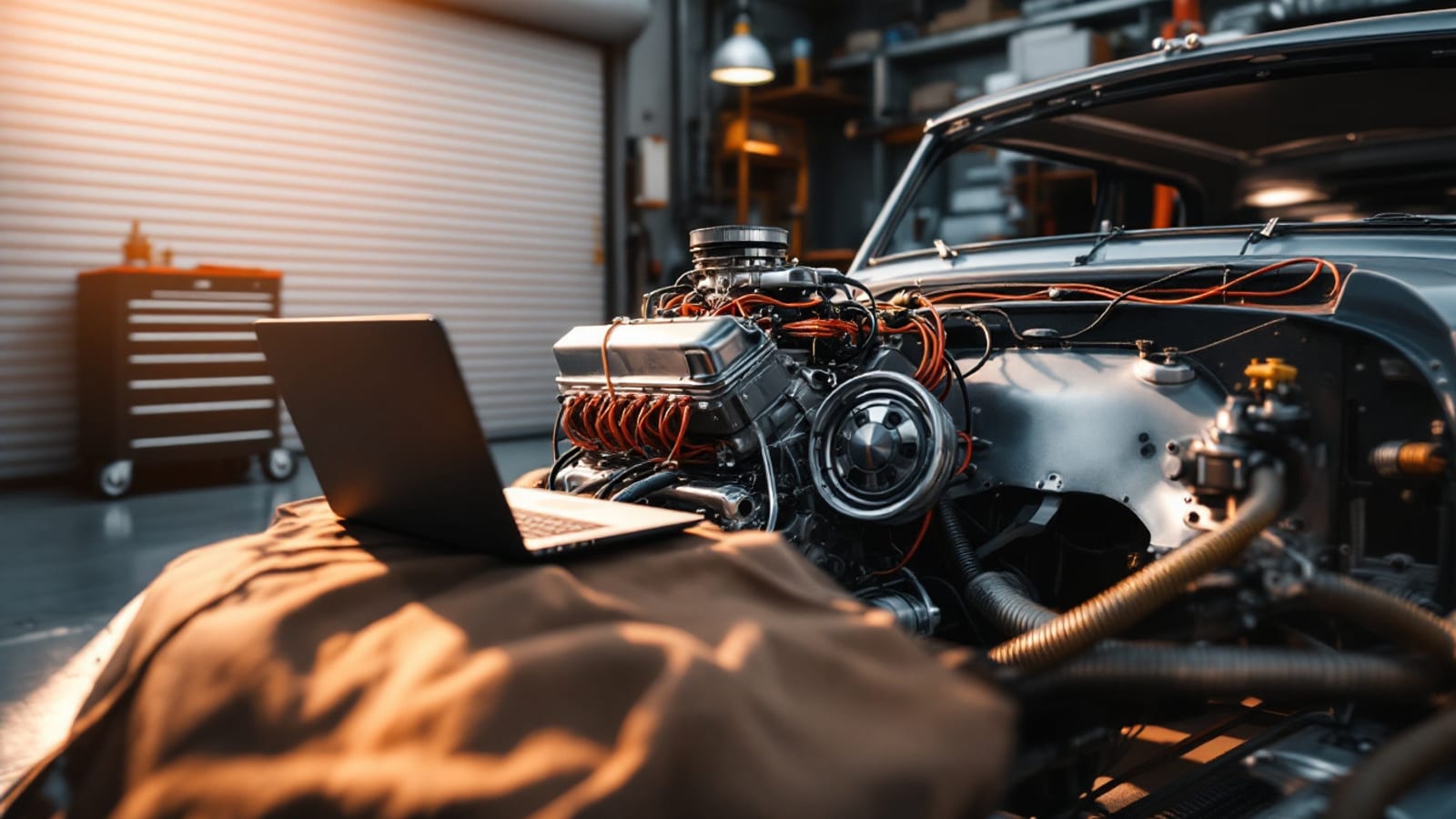
An LS swap fails to tune well for one reason more than any other: the steps get done out of order. Airflow gets calibrated after spark, idle gets chased before a vacuum leak is found, or somebody advances timing on a fuel model that was never correct in the first place. The engine then does something strange, and every subsequent change is a guess layered on a guess.
This is the order that works, and the check that tells you each stage is genuinely finished before you move on. As of July 2026 it reflects current HP Tuners VCM Suite workflow, and it assumes you are using HP Tuners on a swapped LS with the engine physically installed and the harness complete. If your engine cranks and refuses to fire at all, start with the LS swap no-start checklist instead — that is a different problem from calibration.
Stage 0: read and save the file that is already in there
Before you change one cell, read the calibration currently in the computer and save it somewhere you will still be able to find it. Name it with the date and the words "as received". This is the file you go back to when something you did later turns out to be wrong, and it is the only copy that exists.
If the computer came from a donor vehicle, that file also tells you what the factory expected — displacement, injector data, transmission type, which sensors it thinks are attached. Reading it is genuinely the fastest way to learn what your swap is fighting. Our tune file management guide covers a labelling scheme that survives a two-year project.
Stage 1: tell the computer what the car no longer has
A donor computer arrives expecting a whole vehicle. Your swap probably is not that vehicle. Everything it expects and cannot find becomes either a fault code, a limp behaviour, or a hard refusal to run.
The usual list on an LS swap:
- Anti-theft (VATS/PassLock). If the security system is not present in the new chassis, the computer must be told, or it will cut fuel shortly after start.
- Transmission control, if you have gone manual behind an engine whose computer expects to shift an automatic.
- EVAP, if the charcoal canister and purge plumbing are not installed.
- Secondary air injection, on donors equipped with it.
- Rear oxygen sensors, where the swapped exhaust legitimately has nowhere to put them and the vehicle's use makes that lawful. This is a legal question as much as a calibration one — a vehicle driven on public roads is subject to the Clean Air Act tampering provisions, and many states inspect both hardware and readiness monitors. Our emissions and inspection guide walks through where the line sits.
Set these before first start, not after. A car that will not stay running because of an anti-theft cut is indistinguishable from a car with a fuel delivery problem if you are watching from the driver's seat.
Stage 2: first start, and the three numbers that matter
Crank it. The moment it fires, you are looking at three things and nothing else:
- Oil pressure. If it is not there within a couple of seconds, shut it down.
- Fuel pressure. Steady and at the value your fuel system is supposed to deliver.
- Coolant temperature climbing sensibly from a plausible starting value.
Do not tune anything during this window. The only goal is proving the engine is mechanically fed and lubricated. A calibration cannot fix a fuel pump that cannot hold pressure, and continuing to run in that state is how a fresh engine gets damaged before it has ever been driven.
Stage 3: enough idle to log
You do not need a perfect idle yet — you need one stable enough that the car will sit and run while you capture data. Two things get you there:
- Verify the coolant temperature sensor is reading correctly. A sensor reading cold on a warm engine makes the computer add fuel forever, and the resulting rich idle looks exactly like a fuelling calibration problem.
- Find vacuum leaks now. Every hour spent tuning around a leak is wasted the moment you fix it.
If the swap uses a camshaft with meaningful overlap, expect the factory idle targets to be wrong for it and expect the idle airflow requirement to be higher than stock. Raise the target idle speed to something the cam can actually hold, and leave the fine work until after airflow is calibrated — the idle control system is downstream of the air model, so tuning it first means tuning it twice.
Stage 4: calibrate the airflow model
This is the heart of the job, and everything after it depends on getting it right.
An LS computer works out how much fuel to inject by first working out how much air is entering the engine. It does that either from the volumetric efficiency table using speed density, from a mass airflow sensor, or from a blend of both. On a swap, the factory numbers describe the donor's combination, not yours — different cam, different intake, sometimes different displacement.
The method is the same regardless:
- Get the engine to full operating temperature and into closed loop.
- Drive or hold a spread of load and RPM cells, logging short-term and long-term fuel trims.
- Where trims consistently add fuel, the table is under-reporting air; where they consistently pull fuel, it is over-reporting.
- Apply the correction, clear the learned trims, and re-log.
- Repeat until the corrections are small everywhere you actually operate.
The finish line: trims within roughly plus or minus five percent across the cells you drive through, holding steady when warm. Not just at idle. Not just at cruise. Our MAF and VE correction calculator does the arithmetic on the correction factors so you are not doing it in your head between pulls.
If you are running a MAF as well, sort VE first and the MAF second. A MAF curve layered on top of a wrong VE table produces a car that behaves acceptably in the exact conditions you tuned in and badly everywhere else.
Stage 5: fuelling targets and injector data
With the air model honest, the fuel side becomes straightforward — and it is only now that it becomes meaningful, because until this point the computer did not know how much air it was fuelling for.
Two things to confirm:
- Injector data matches the injectors physically installed. Slope, offset, and breakpoint. Wrong injector data produces a car that runs correctly in one part of the range and badly in another, which people then misdiagnose as an airflow problem and "fix" by corrupting a VE table that was fine. Our injector data page and the injector size calculator cover the checks.
- Power enrichment targets are appropriate for your fuel and compression. This is the commanded air-fuel ratio at wide-open throttle, and it is your primary safety margin.
Then verify with a log: does the delivered air-fuel ratio match what the computer commanded? The AFR and lambda calculator converts between units if your wideband reports lambda and your tables are in AFR. If commanded and delivered disagree, do not proceed to spark — something in the previous two stages is still wrong.
Stage 6: spark, conservatively and last
Timing is where power lives and where engines die, which is why it goes at the end.
Start below where you expect to finish. Log knock retard through the load range. Advance only where the engine shows no retard, and only in small steps, re-logging each time. If retard appears and repeats in the same cells, you have found the limit for your fuel, compression, and intake air temperature — stop there. A number that works on somebody else's LS on a cool evening is not a target for your engine on a hot afternoon.
Pay particular attention to how timing behaves as intake air temperature climbs. Swaps often have worse underhood heat management than the donor vehicle did, and a calibration that is safe on the first pull can be marginal on the fourth.
Stage 7: verify, then verify hot
The tune is not finished when the car makes power. It is finished when you have a datalog proving it is safe in the conditions you will actually use.
Capture a full pull and check four channels:
| Channel | What good looks like | What it means if it is wrong |
|---|---|---|
| Commanded vs delivered AFR | Tracks closely through the pull | Fuel delivery or airflow model is still off |
| Knock retard | At or near zero under load | Timing is beyond what this fuel and combination supports |
| Fuel pressure | Steady under full load | Pump or regulator cannot keep up — stop before more timing |
| Intake air temperature | Not climbing steeply pull over pull | Heat soak; your safe timing shrinks as the car gets hot |
Then do it again when the engine is heat-soaked, because that is the condition that finds problems. Our datalog channels reference explains what each number represents, and the how to read a datalog guide walks through a full pull line by line.
Where TuneVault fits in this sequence
TuneVault is a guided copilot for exactly this process. It reads your VCM Editor tables from screenshots, checks the injector data against the parts you say are installed, flags lean wide-open-throttle regions and aggressive timing before you flash, and gives you an ordered change list rather than a pile of suggestions. Then you upload a VCM Scanner log and get a plain go or no-go on the safety channels.
For a swap specifically, the ordering is the valuable part — the tool works the same sequence described above, so you do not end up advancing timing on an air model that was never verified. See the LS swap tuning page for what the workflow looks like, or start a tune and find out where your current file stands.
The bottom line
An LS swap is not harder to tune than a factory car — it just has more assumptions that need correcting, and they have to be corrected in the right order. Disable what is not there, prove the engine is fed, get a loggable idle, fix airflow, fix fuelling, then and only then touch spark, and verify everything hot before you trust it. Every stage has a specific finish condition, and the discipline of not moving on until you hit it is what separates a swap that runs beautifully for a decade from one that never quite feels right.
Frequently asked questions
What order should I tune an LS swap in?
Disable what the swap no longer has, get a clean first start and confirm oil pressure and fuel pressure, then sort idle so the car will sit still long enough to log. After that, calibrate the airflow model — VE first, then MAF if you are running one — then set fuelling targets, then spark, then verify everything under load with a datalog. Doing spark before airflow is the classic mistake, because you are advancing timing on top of a fuel model that is still wrong.
Do I need to disable VATS on an LS swap?
If your donor computer expects the factory anti-theft system and the swapped chassis does not have it, yes — the computer will either refuse to run or will cut fuel after a couple of seconds. The same applies to any option the harness no longer carries: transmission control on a manual swap, EVAP if the system is not plumbed, secondary air, and rear oxygen sensors if you have deleted them in a way that is legal for your vehicle's use. Every one of those throws codes or actively interferes with running until the calibration is told the hardware is gone.
Should I run MAF or speed density on an LS swap?
Speed density is simpler on a swap because it removes one sensor and one calibration table from the problem, and a well-sorted VE table runs an LS very well. A MAF adds accuracy across changing conditions and helps with unusual cams, but only after the VE table is already correct — a MAF layered over a bad VE table just hides the error. Most swappers get the car running and driving on VE first and decide about the MAF afterwards.
How do I know my LS swap VE table is finished?
Short-term and long-term fuel trims sit within roughly plus or minus five percent across the cells you actually drive through, and they stay there when the engine is fully warm. If trims are flat at idle but swing hard at cruise, the table is only right in the region you have been logging — drive a wider load and RPM spread and re-check. A finished VE table is one where the correction the computer has to apply is small everywhere, not just where it is easy.
Why does my LS swap idle badly after the tune?
The usual causes are an airflow error the idle control is fighting, an idle air control target that does not match the cam, a coolant temperature sensor reading wrong so the engine thinks it is cold, or a vacuum leak the calibration is compensating for. Fix the mechanical and sensor issues before touching idle tables, because tuning around a leak produces a calibration that falls apart the moment the leak is repaired.
How much timing is safe on an LS swap running pump gas?
There is no single number, because it depends on compression ratio, camshaft, fuel quality, and intake air temperature. The safe method is to start conservative, log knock retard, and only advance where the engine shows no retard with margin left. An LS that is showing repeated knock retard under load is telling you to stop advancing regardless of what the number on the table says.
Can I tune an LS swap without a dyno?
Yes, and most swaps are tuned exactly that way. What a dyno gives you is repeatable load and a controlled environment, which matters most on aggressive or forced-induction builds. A naturally aspirated street swap can be calibrated safely with careful road logs, provided you actually capture and read those logs rather than deciding it feels fine.