Nitrous Tuning Basics: Timing Retard, Fuelling and Safety Switches
Nitrous adds cylinder pressure faster than any other bolt-on, which is why it punishes a lazy calibration hardest. How much timing to pull per shot size, why dry kits and mass-air cars fight each other, which safety interlocks are not optional, and what the datalog must show before a second pass.
By TuneVault
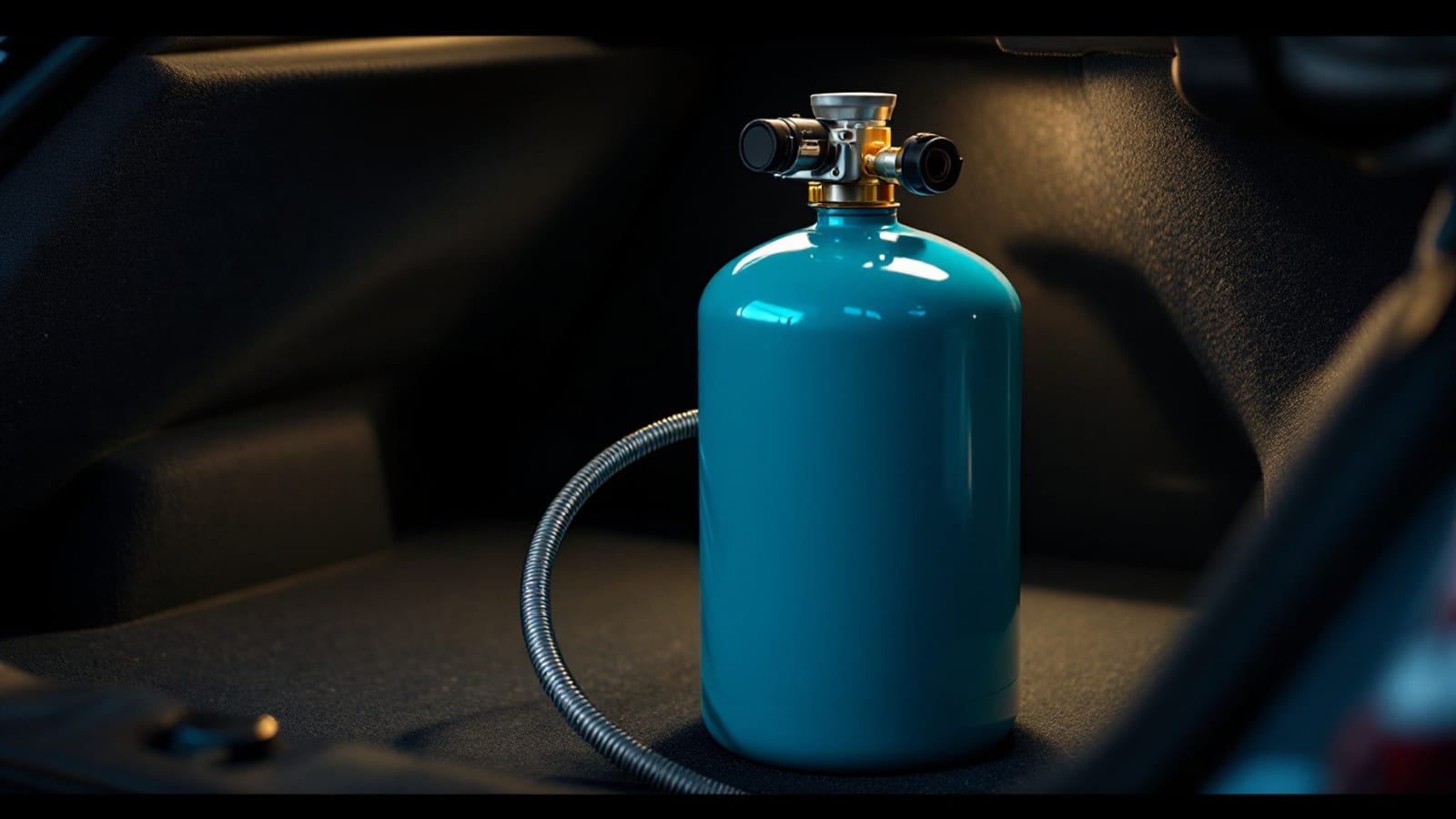
Nitrous oxide is the fastest way to add cylinder pressure to an engine, and that is both the appeal and the entire problem. A turbocharger builds gradually and gives the calibration time to respond. A nitrous solenoid opens and the combustion environment changes completely within a fraction of a second.
As of September 2026 the honest framing is that nitrous does not require an exotic calibration, it requires a disciplined one — conservative spark while the system is active, verified fuel delivery, and interlocks that make an accidental activation impossible. Most nitrous engine failures trace back to one of those three being assumed rather than checked.
This article covers naturally aspirated gasoline engines with factory emissions equipment intact. Nothing here involves removing or defeating emissions equipment, which is illegal under federal and state law.
What nitrous actually does
Nitrous oxide is not a fuel. It is an oxygen carrier that decomposes in the heat of combustion and releases oxygen the engine could not otherwise ingest. Three consequences follow, and each one maps to something in the calibration.
More oxygen demands more fuel. The added oxygen is useless — worse than useless — without proportionally more fuel. This is where lean failures come from.
Cylinder pressure rises sharply and early. The burn is more energetic, peak pressure arrives sooner, and the timing that was optimal without the shot is now too advanced. This is where detonation comes from.
The charge is cooled on the way in. Liquid nitrous expanding in the intake tract drops charge temperature significantly, which is genuinely helpful and partially offsets the knock tendency. It does not offset it entirely, and it is not a substitute for pulling timing.
The first and second consequences are the entire tuning job. Everything else is instrumentation and interlocks.
Wet, dry and direct port — and why the calibration cares
Wet kits introduce nitrous and supplementary fuel together, usually through a plate or a nozzle. The kit's jetting handles most of the fuel requirement, so the calibration's job is mainly spark retard. This is the most forgiving arrangement for a self-tuner.
Dry kits introduce nitrous only, and expect the engine's own injectors to supply the extra fuel. That fuel must come from somewhere — either the calibration commands it, or on some systems fuel pressure is raised to make existing injector pulse widths flow more. Either way, the responsibility shifts from the kit to the tune, and the failure mode is a very lean cylinder within a second of activation.
Direct port delivers to each runner individually. It costs more and installs harder, and in exchange it solves the distribution problem — every cylinder receives the same mixture. On a larger shot, distribution is usually the thing that decides whether one cylinder fails before the others.
There is a platform interaction worth flagging. On a mass air flow car, the sensor sits upstream of where nitrous is introduced, so it cannot see the added oxygen and will not increase fuel on its own. On a speed density car, manifold pressure changes slightly, but not in a way that represents the added oxygen mass either. In both cases the fuel must be commanded deliberately, not expected — which is why "the ECU will sort it out" is the most dangerous sentence in this subject.
Timing retard by shot size
A conventional starting point is one and a half to two degrees of retard per fifty horsepower of shot, applied only while the system is active. That figure is a starting point that has to be validated on your combination, not a specification.
| Shot size | Typical starting retard | Fuel strategy | Main risk |
|---|---|---|---|
| 50 hp | 1.5–3° | Wet kit jetting, or small commanded enrichment | Complacency — this is where habits form |
| 75 hp | 3–4° | Wet or well-set-up dry, wideband mandatory | Fuel pump headroom |
| 100 hp | 4–6° | Wet preferred; verify injector duty | Distribution between cylinders |
| 150 hp | 6–9° | Direct port or excellent wet plate | Detonation, one lean cylinder |
| 200 hp+ | Purpose-built calibration | Direct port, dedicated fuel system | Everything; outside DIY scope |
Higher compression, lower octane, or a hot day all push the retard requirement upward from these figures. The honest procedure is to start at the high end of the range, make one pass, and read the log. Removing retard one degree at a time with clean logs between is slow and boring and it is how engines survive.
Where that retard lives in the file depends on the platform. Some calibrations support a separate spark table selected when a nitrous input is active. Others require the retard to be applied through an available modifier. The general discipline is the same as ordinary spark timing work: the difference is that the penalty for being wrong arrives in one pass rather than accumulating.
Fuelling: where the failures actually happen
Ask what the engine is running under the shot and you want a measured number, not an estimate.
A wideband is not optional. Narrowband sensors cannot resolve anything useful in the rich region where a nitrous engine operates — they report "rich" and nothing more. The reasoning is covered fully in do you need a wideband before tuning, and nitrous is the clearest case where the answer is unambiguous.
Injector headroom must exist before the shot does. Adding fuel for a hundred horsepower of nitrous requires injectors that were not already near saturation. If duty cycle is at ninety percent without nitrous, there is nothing left to add — the calibration will command fuel the hardware cannot deliver, and the mixture goes lean at the worst moment. Work through injector duty cycle and fuel pump headroom before buying a kit, not after.
Fuel supply pressure must hold under the new demand. A pump that is adequate without nitrous can fall away with the extra flow. Log fuel pressure if the car can, and fit a fuel pressure safety switch that cuts the nitrous system if pressure drops below a threshold.
Power enrichment interacts with all of this. The engine is already in open-loop enrichment at wide-open throttle, and the nitrous fuel is added on top of that. Understanding what the base commanded mixture is before the shot arrives is what open loop, closed loop and PE mode covers, and it is the number your retard decisions sit on top of.
Safety switches that are not optional
Every one of these exists because of a failure that happened to somebody.
Wide-open-throttle switch. The system must be incapable of arming at part throttle. Nitrous at partial throttle with a nearly closed intake is how intake manifolds come apart.
RPM window. A lower bound below which the engine speed is too low to handle the pressure spike, and an upper bound past which the shot achieves nothing. Both matter.
Fuel pressure safety. Cuts the nitrous the instant supply pressure falls. This is the interlock that converts a fuel delivery problem into a slower car instead of a damaged engine.
Bottle pressure management. Strictly a consistency tool rather than a safety device, but inconsistent bottle pressure changes delivered flow, which changes the mixture — so treating it as a safety-adjacent concern is reasonable.
Purge before the pass. Clearing the line means the shot arrives fully rather than as gas followed by liquid, which makes the first half second predictable.
A progressive controller on larger shots. Ramping the shot in over a fraction of a second rather than all at once reduces the shock to the driveline and gives the combustion environment time to stabilise. On bigger systems this is standard practice rather than a luxury.
What the datalog has to show
Make one pass. Then read, before making a second.
Knock retard is the pass or fail. Any meaningful knock retard during the shot means the timing is too advanced for this combination and the next change is more retard, not less. The calibration of what counts as normal versus alarming is in how much knock retard is normal.
Wideband lambda through the entire activation window. Not the average — the trace. A brief lean spike at the moment of activation is a real event even if the average looks acceptable, and it usually means the fuel is arriving slightly after the nitrous.
Fuel pressure, if instrumented. A drop that coincides with activation is a supply problem.
Injector duty cycle. If it reaches saturation during the shot, the fuel system is the limit and the shot size is above what the car can support.
Engine speed and throttle position to confirm the interlocks behaved — that the system engaged inside the window you configured and not outside it.
If any of those channels looks wrong, the correct next action is a change to one variable, not a second pass with the same setup and more hope.
The mechanical preconditions
Nitrous finds weakness rather than creating it. Before the first activation:
Spark plugs one heat range colder, gapped tighter than standard — a wider gap is harder to fire in a denser, higher-pressure cylinder. Fresh fluids and a cooling system in genuinely good condition. A healthy fuel pump and filter. Compression readings that are even across cylinders. Everything in the pre-tune mechanical checklist applies here with less tolerance for "probably fine".
An engine with a marginal component survives normal driving and fails under nitrous. That is not the nitrous being unreasonable; it is the nitrous being the first thing to ask a real question.
Legality and venue rules
Nitrous rules vary by state and by venue, and this is a check-locally subject rather than a settled one. Common patterns include restrictions on a connected bottle on public roads, bottle certification and re-certification dates at tracks, and mounting and blow-down requirements in tech inspection.
None of that is affected by the calibration. What is worth stating clearly is that adding nitrous does not require touching emissions equipment. A car with a nitrous system and an intact emissions system is a different thing from a defeated one — the distinctions, including how inspections actually work, are in the emissions inspection and CARB EO guide.
The summary
Nitrous is not difficult to calibrate. It is unforgiving of being calibrated casually.
Pull timing generously and give it back one degree at a time with clean logs. Know where the extra fuel is coming from and prove the fuel system can deliver it. Fit the interlocks so an accidental activation is impossible rather than unlikely. And read the first pass before making the second — the log from pass one contains everything you need to decide whether pass two is safe, and no amount of confidence substitutes for it.
Frequently asked questions
How much timing should I pull for nitrous?
A widely used starting point is one and a half to two degrees of retard per fifty horsepower of shot, applied only while the system is active, and that is a starting point rather than an answer. The correct figure depends on compression, fuel octane, charge temperature and the kit's distribution quality. Start conservative, read knock retard on the first pass, and remove retard in small steps only if the log is clean.
What is the difference between a wet and a dry nitrous kit for tuning?
A wet kit sprays nitrous and additional fuel together, so the extra fuel arrives with the extra oxygen and the calibration mainly handles spark. A dry kit sprays only nitrous and expects the engine's own injectors to supply the extra fuel, which means the calibration has to add that fuel deliberately. Dry kits put far more responsibility on the tune and far less margin for a mistake.
Do I need a wideband before spraying nitrous?
Yes, and this is not a preference. Narrowband sensors cannot report a meaningful number in the rich power-enrichment region where a nitrous engine lives, so without a wideband you have no visibility of the one channel most likely to destroy the engine. Spraying without knowing your actual air-fuel ratio under the shot is the single most common way nitrous engines fail.
Which nitrous safety switches actually matter?
A wide-open-throttle switch so the system cannot arm at part throttle, an rpm window so it cannot engage below the engine speed where it is safe or above the point where it is pointless, and a fuel pressure safety that cuts the system if supply drops. Bottle pressure control matters for consistency rather than safety, but inconsistent bottle pressure is itself a cause of unexpectedly lean conditions.
Can I use nitrous on a stock engine?
Modest shots on a healthy, stock, well-maintained engine are common practice, and the phrase doing the work in that sentence is healthy. Nitrous finds pre-existing weakness — tired rings, a marginal fuel pump, worn plugs with too wide a gap, a cooling system already at its limit. The mechanical inspection before the first spray matters more than the size of the shot.
Why did my engine go lean the moment the nitrous engaged?
On a dry kit it usually means the calibration is not adding the fuel the kit assumes it will, or the injectors have no duty cycle headroom left to add it. On a mass-air car it can also mean the sensor cannot see the added oxygen and therefore does not increase fuel. On any kit it can mean fuel supply pressure fell under the additional demand.
Is nitrous legal on a street car?
Rules vary by state and by venue, and this should be checked locally rather than assumed. The general pattern is that possession and use are regulated differently, some jurisdictions require the bottle to be disconnected on public roads, and tracks have their own bottle certification and mounting requirements. Nothing about a nitrous installation requires removing or defeating emissions equipment, which is illegal and not something this site assists with.